
Private IPFS Cluster on Wasabi S3
Terabytes of blocks on object storage, not SSDs.
~6–7TB → ~100GB
local disk per S3 replica
3 regions
Wasabi block replicas
Millions
cluster pins in sync
Private swarm
no public DHT
Overview
I built a private IPFS Cluster where most content lives in Wasabi S3-compatible buckets, not on expensive local volumes.
Public IPFS was not a fit. We needed a closed swarm, coordinated pinning, and storage that could grow without buying another 6–7TB disk per node. The answer was hybrid: disk-based nodes for speed and bootstrap, plus S3-backed Kubo nodes that keep metadata locally and blocks in Wasabi.
The problem
A disk-only IPFS node holding millions of pins used about 6–7TB locally. Scaling that across peers meant:
- High persistent-disk cost on cloud VMs
- Slow, expensive growth every time the pinset grew
- Harder disaster recovery — everything tied to a single volume
- Operational risk when disks filled and GC was not automatic
The solution
Custom Kubo images with the go-ds-s3 plugin, coordinated by IPFS Cluster. S3 nodes stay around ~100GB local plus ~160GB in Wasabi instead of another 6–7TB volume. Cluster metadata still syncs so every node knows the same pinset; blocks are fetched from S3 or peers on demand.
Disk master
Bootstrap peer, fast local reads, full block set on disk
S3 nodes
Blocks in Wasabi, LevelDB metadata and a ~70GB local cache
IPFS Cluster
Shared pinset (CRDT), recover and sync across peers
Wasabi
Multi-region buckets; region and endpoint have to match — S3-compatible still returns InvalidAccessKeyId / PermanentRedirect if they do not
Architecture
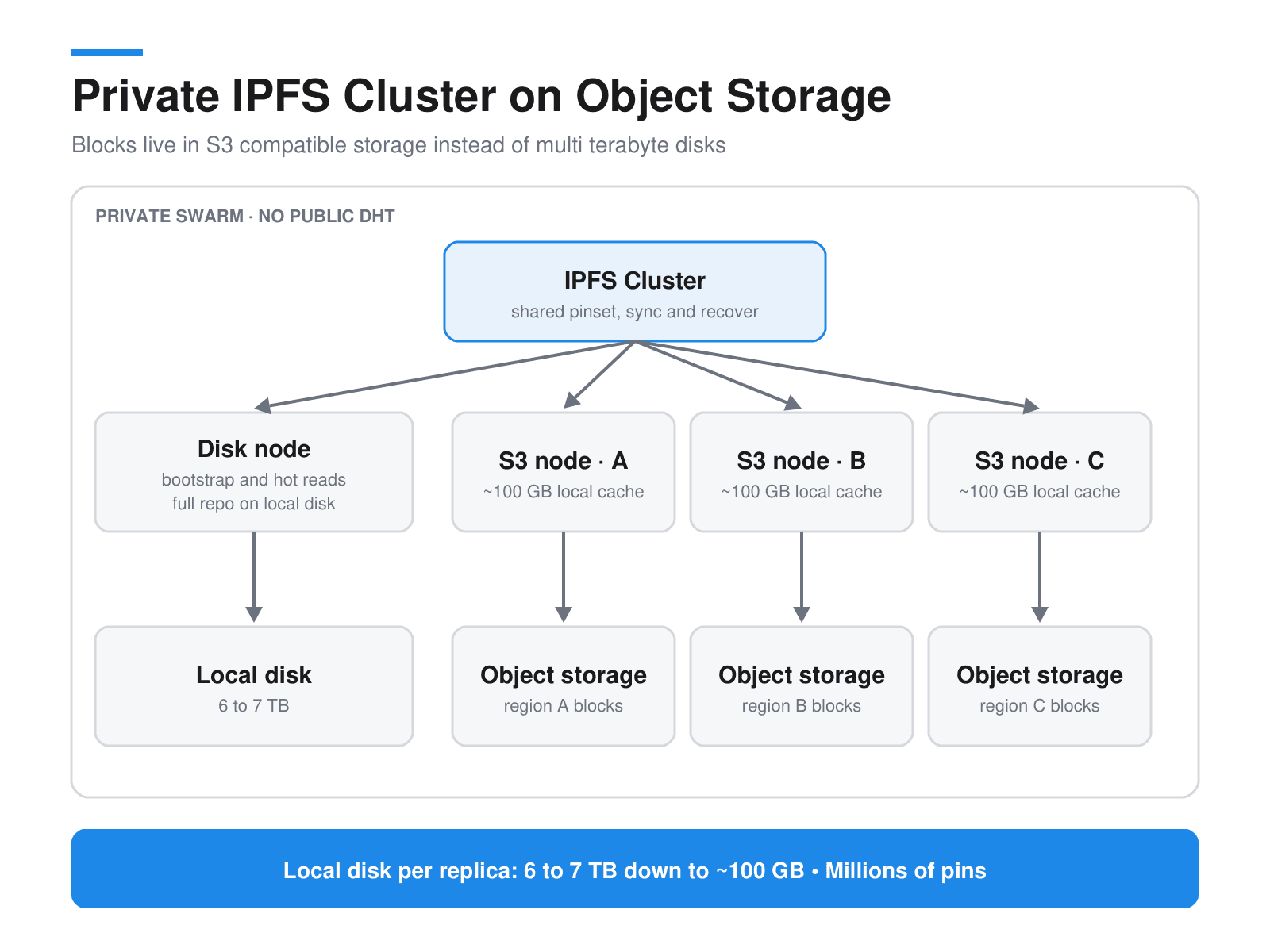
swarm.txt
Private IPFS Cluster
├── Disk node(s)     → full local repo (~TB scale)
└── S3 nodes         → Wasabi blocks + small local cache
        ├── LevelDB  → CIDs / datastore metadata
        └── Wasabi   → actual IPFS blocks
What I implemented
- Custom Kubo + go-ds-s3 Docker images — the S3 plugin needs two different JSON shapes (config vs datastore_spec); getting that wrong means the daemon never starts
- Multi-node IPFS Cluster with unique peer names, isolated Docker networks, and a shared cluster secret. Wasabi credentials bound to the right regional endpoint, not a generic S3 URL
- Private swarm: no public bootstrap, no reprovide noise, no public DHT
- StorageMax plus cron GC so the local cache does not fill the VM
- Ops scripts: pin-count compare, sync/recover, disk monitor, emergency cleanup
- Pin-tracker tuning for millions of pins (queue size and concurrent pins) so recoveries do not stall
Results
- Most replica storage moved from TB-class disks to Wasabi object storage — flat S3-compatible pricing, no AWS egress tax
- Cluster-level pinset in the millions without giving every node a 7TB volume
- Replicas across three Wasabi regions, plus disk nodes for the hot path
- Automated GC and disk alerts keep S3 nodes in a ~100–200GB local envelope
- Closed cluster: pins and swarm traffic stay inside the private network
Stack
Have a project in mind?
Let's build something together.