
Private by Default Service Mesh
One Istio mesh, two gateways: public traffic through the edge, internal traffic never leaving the VPC.
Private by default
internal APIs never leave the VPC
Wildcard TLS
issued from AWS Private CA
Public / internal
two gateways on one mesh
Pod Identity
no node wide AWS credentials
Overview
A platform usually starts out with one way in: a public load balancer per service. That is fine until some of those services are only ever meant to be called by other services, or by the people running the platform. At that point a public endpoint with an authentication check in front of it is doing more work than it should.
I separated the two. Anything public keeps its route through Cloudflare and an Istio public gateway. Anything internal moves behind a second gateway that only answers inside the VPC, on a private Network Load Balancer with no public IP, using names that only resolve on a Route 53 private hosted zone. Certificates come from AWS Private CA with ACM wildcards, so adding an internal service does not mean issuing another certificate by hand.
The problem
Internal services were exposed the same way public ones were, which made the security story depend entirely on what sat in front of each endpoint.
- Internal APIs reachable from the internet, protected only by application level checks
- A public load balancer per service, and cost and attack surface growing with each one
- Certificates issued by hand for internal hostnames, with expiries nobody tracked
- Internal hostnames resolvable publicly, which leaked the shape of the platform
- No single place to say what is public and what is not
The solution
Treat public and internal as two separate paths through one mesh. Exposure becomes a property of the route, not an accident of how the service was deployed.
Public edge
Cloudflare with WAF, bot controls and rate limits in front of the public gateway
Public gateway
Istio gateway carrying only the routes meant to be internet facing
Private DNS
Route 53 private hosted zone, so internal names resolve only inside the VPC
Private entry
Internal NLB with no public IP, reachable only from inside the network
Internal gateway
A second Istio gateway terminating TLS for internal routes
TLS
AWS Private CA with ACM wildcards, so new internal hosts need no manual certificate
Identity
EKS Pod Identity and Pod Security Admission instead of node wide credentials
Secrets
Vault and External Secrets Operator syncing into the cluster
Delivery
Argo CD and FluxCD, so routing and policy changes land through git
Architecture
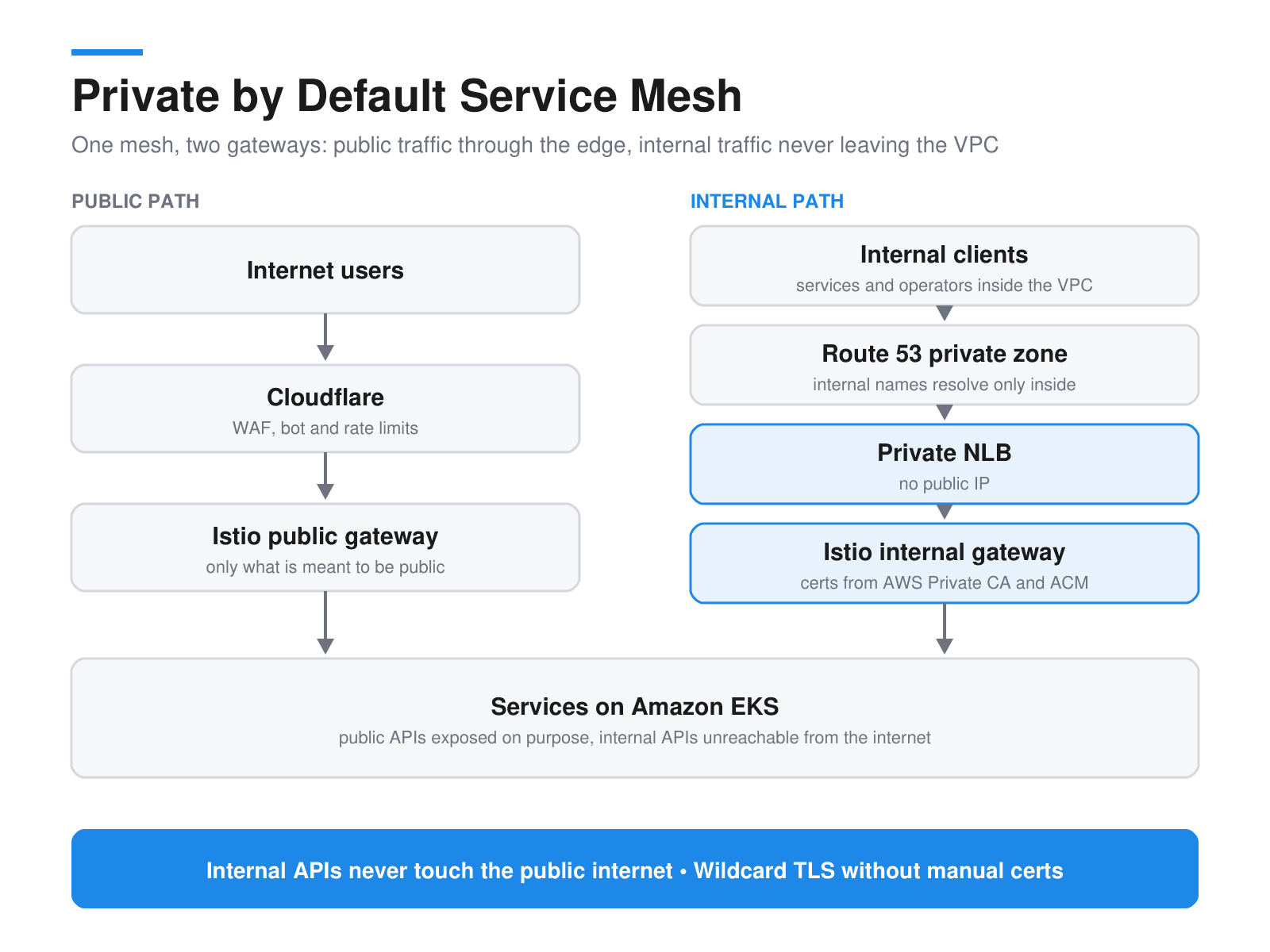
mesh.txt
Internet
    → Cloudflare (WAF, bot, rate limits)
    → Istio public gateway
         └── public VirtualServices only

Internal client
    → Route 53 private hosted zone
    → private NLB (no public IP)
    → Istio internal gateway (AWS Private CA + ACM wildcard)
         └── internal VirtualServices
What I implemented
- A second Istio gateway for internal routes, so public and internal exposure are separate objects rather than a naming convention
- AWS Private CA as the internal certificate authority, with ACM wildcards so a new internal host does not need its own certificate
- An internal Network Load Balancer with no public IP, as the only entry point to the internal gateway
- Route 53 private hosted zones, so internal hostnames do not resolve outside the VPC
- Cloudflare WAF, bot controls and rate limits kept in front of the public gateway
- EKS Pod Identity and Pod Security Admission so pods carry their own scoped AWS access instead of borrowing the node's
- Vault and External Secrets Operator to sync secrets into the cluster rather than baking them into manifests
- Routing and policy managed through Argo CD and FluxCD, so exposure changes are reviewable in git
- IAM policy names namespaced per environment, since reusable Terraform modules otherwise collide on AWS global unique names
Before / after
Before
- Internal APIs on public load balancers
- A load balancer per service
- Certificates issued by hand
- Internal hostnames resolving publicly
- Exposure decided per deployment
After
- Internal APIs only reachable inside the VPC
- Two gateways on one shared mesh
- Wildcard TLS from AWS Private CA
- Private hosted zones for internal names
- Exposure is a routing rule in git
Results
- Internal traffic stays inside the VPC, so an internal API is not one misconfiguration away from being public
- Exposing a new internal service is a routing rule, not a new load balancer and a new certificate
- Fewer load balancers, and less attack surface to keep track of
- Certificates renew without anyone remembering to do it
- What is public and what is not is visible in git, not inferred from AWS console settings
Stack
Have a project in mind?
Let's build something together.